Guide
Why Sub-Zero Ice Makes Your Water Taste Weird
If a glass of water tastes fine on its own but turns stale, musty or faintly chemical the moment ice goes in, the ice is the culprit, not the water. Cubes act like a sponge for smells in the freezer air, they go flat after weeks in the bin, and they carry whatever the filter and the ice maker add or fail to take out. The fastest way to narrow it down takes two glasses: pour one from the dispenser or the tap with no ice, fill the other with ice and let it melt, then taste both side by side. If only the melted ice is off, the problem lives in the freezer; if both are off, look upstream at the filter and the supply. In Mission Hills, where plenty of houses are decades older than the refrigerator built into the kitchen, that supply line can be part of the story too.
Ice tastes bad but the water is fine
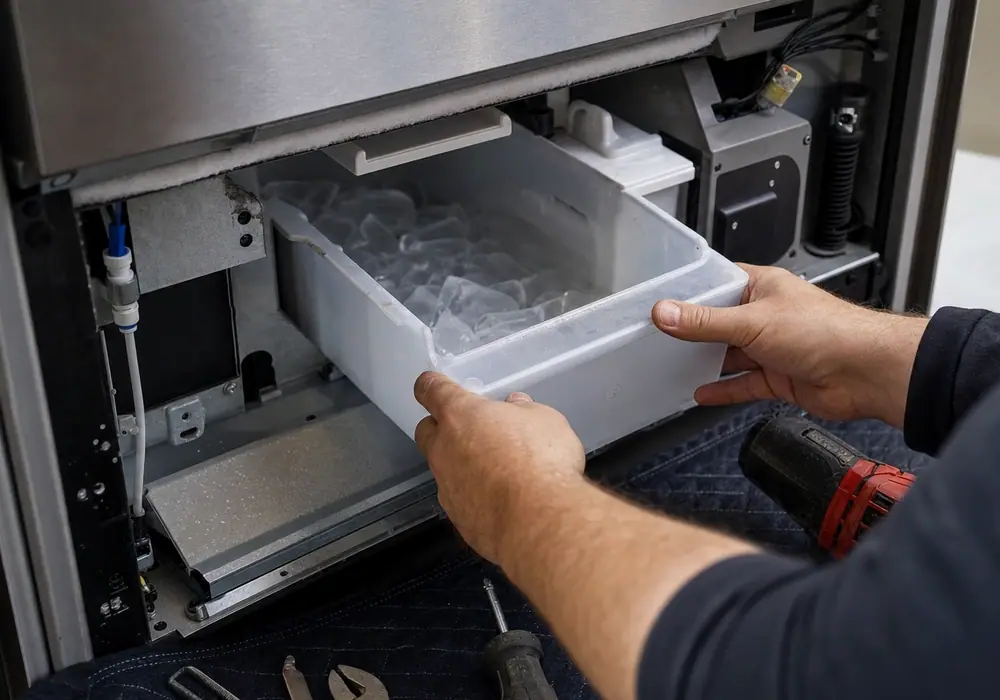
This is the most common version of the complaint, and it rarely means anything is broken. Ice has a large surface for its weight, and a freezer keeps its air moving, so cubes soak up odors from fish, onions, half-covered leftovers and even the cardboard of frozen food boxes. Cubes that sit for weeks slowly shrink as they sublimate and keep absorbing whatever drifts past them, which is why old ice tastes both flatter and stronger than a fresh batch. Many Sub-Zero built-ins keep fresh-food and freezer air apart with separate cooling systems, so on those models a smell in the ice almost always comes from something stored in the freezer itself rather than from the refrigerator side. Before calling anyone, work through these simple steps:
- Empty the whole bin, wash it by hand in warm water with a little baking soda, rinse it well and dry it before it goes back in.
- Seal or wrap anything with a strong smell, and discard food whose packaging has grown a coat of frost.
- Keep an open box of baking soda at the back of a freezer shelf and swap it every few months.
- If the household uses little ice, dump the older cubes now and then instead of letting them age in the bin.
When the water tastes off too, start with the filter
If water from the dispenser, or ice melted in a clean glass, tastes as bad as the cubes, the cause sits upstream of the freezer and the filter is the first suspect. A carbon cartridge traps chlorine, odor compounds and fine sediment until it is saturated, after which the taste slips back a little at a time, so most people notice it weeks late. On Classic (CL) units and on the DET and DEC Designer models, a cartridge's rated life ends at 12 months or 750 gallons (2,839 L) of water, whichever arrives first, and a lit indicator, weaker flow or hollow cubes are all reasons to change it early. NSF International has tested the Classic (CL) cartridge against NSF/ANSI 42, which deals with taste, odor and chlorine, and NSF/ANSI 53, which deals with health-related contaminants; its data sheet assumes water from 40°F-100°F, a supply of 35-120 psi and a 0.78 gpm service flow. Before buying a cartridge, though, confirm your unit actually has one, because many Sub-Zero products do not:
- No cartridge lives inside the UC-24, the DEU undercounter refrigeration or the ID drawers, and a DEU1550I arrives without one, so for owners of those a bad flavor has to come from the household supply, a filter under the sink or the ice maker's own parts.
- Part 4204490, which swaps freely with 9030868, is the twist-in style you will find in Classic (BI, CL) refrigerators, in DET and DEC Designer units, and in the 648PRO, PRO3650 and PRO4850.
- Some older BI units take a two-prong push-in cartridge instead. Its microbiological version, 7023811, can no longer be bought, and 7045454 took its place as a color, taste and odor filter.
Why ice can taste like chemicals or plastic
A sharp chemical or plastic edge that appears suddenly nearly always follows something new: a fresh filter, a replaced water line, a new ice maker, or a cleaning cycle that was not fully rinsed through. A new carbon cartridge sheds loose carbon dust and trapped air until it has been flushed. That is the reason for Sub-Zero's advice after a cartridge swap: on a Classic (CL) or Designer (DET, DEC) model with no dispenser, the first two complete bins go down the sink, a dispenser model gets two minutes of running water instead, and a UC-15I needs only its first batch dumped. Fresh plastic tubing can lend its own taste for several days. A reverse osmosis unit is acceptable to Sub-Zero provided the pressure it delivers stays steady within 35-120 psi; in that setup the refrigerator's own cartridge, push-in or twist-in, gets bypassed, and copper has no place in the tubing downstream of the RO system, since very pure water draws metal out of it and tastes of it. Bypassing a Classic (BI) filter with plug 7011209, or pulling out a twist-in cartridge, leaves the life monitor counting down for nothing; five presses of the white reset button on the filter's left side, all inside seven seconds, turn that monitor off.
Hard water and the undercounter ice maker
Mission Hills is served by the City of San Diego's water, which is hard, and the minerals that stay dissolved in a glass end up concentrated on the freezing plate, the water trough and the sensors of an ice maker that cycles all day. That scale gives ice a chalky, flat or faintly metallic taste and can leave white flakes in the bottom of a drink, and freestanding undercounter ice makers suffer most because they never stop cycling water. For the Designer Series Undercounter Ice Maker, Sub-Zero's schedule is a clean at installation and then one every three to six months as your hardness dictates; the built-in reminder defaults to three months, and every session uses 1/2 cup of descaler followed by 1/2 tablespoon of sanitizer. The details for a UC-15I differ, and they are worth knowing if one sits in your bar or kitchen island:
- Twice a year it wants a clean and a sanitize. Press CLEAN and empty the bin; at the flashing light the machine takes 4 ounces (115 ml) of cleaner, and a second pass takes 1 tablespoon (15 ml) of sanitizer. Each pass lasts roughly 30 minutes and cannot be stopped once begun.
- Its filter is part 7042803, which superseded 7012333. Change it twice a year, after a long shutdown, or when REPLACE FILTER glows red, which happens after 8000 ice-making cycles; holding CLEAN for 6 seconds clears that light after the swap.
- Cleaning solutions sold for the 315I will not work in a UC-15I or DEU1550I, which share their own pair, and the bottle once called cleaner now reads descaler with the same formula inside.
- Behind the kickplate is its condenser, which wants brushing off on the same six-month rhythm.
A simple routine that keeps ice tasting clean
Most taste complaints never come back once a household settles into a light, regular routine. The aim is to keep the cubes young, the filter inside its rated life, and the ice maker free of scale, so the freezer is making ice from water that already tastes good. A short checklist for a busy kitchen, whether it sits in an older home in Presidio Hills or a newer remodel in Bankers Hill:
- Compare plain water and melted ice whenever a taste appears, so you fix the right thing first.
- Wash the bin every month or two, and never let cubes sit for weeks unused.
- Replace the filter on its interval, mark the date on the housing, and discard the first ice it makes.
- Descale an undercounter ice maker on its own schedule, and lean toward the shorter end of the range with local hard water.
- Book preventive maintenance for the condenser, the seals and the water connections if you would rather not do it yourself.
When a bad taste points to a real fault
A taste that survives a clean bin, a fresh filter and a descale cycle can point to a mechanical cause, especially when it arrives together with a Sub-Zero ice maker not making ice or making much less of it. Low or unsteady water pressure produces small, hollow or cloudy cubes. Each model has its own window, 20-100 psi on some and 35-120 psi on others, and because Sub-Zero ships no gauge, ask a plumber to take the reading. A freezer running warm lets ice partly thaw and refreeze into clumps that hold odors, and a condenser furred with dust makes the whole system strain. Sub-Zero's advice is to clean it every six to twelve months, sooner with pets in the house, taking care with the aluminum fins; chemical sprays are unnecessary and the maker advises against them. A weeping fill valve or a cracked supply line can leave stale water standing in the mold, and if you find water under the unit, our guide to tracing a Sub-Zero refrigerator leak shows where to look. For an ice maker that tastes wrong and has slowed down, see ice machine repair in Mission Hills and Old Town, or call (858) 400-4615 to arrange a visit anywhere from Middletown to Morena.
Questions
Frequently asked questions
What are the signs of a dying refrigerator?
The clearest signs are compartments that no longer hold their set temperature, a compressor that seems to run without a break, frost creeping across the freezer walls, and food that spoils sooner than it used to. The ice often warns you first: smaller cubes, a slower harvest and clumps that melted and refroze. Any of these deserves a diagnosis before a full load of food is lost. That is a two-minute call to Sub-Zero Repair Mission Hills on (858) 400-4615.
How do I get the plastic taste out of my ice maker?
Flush it out: throw away the first several batches, wash the bin in warm water with a spoonful of baking soda, and run water through the dispenser if your model has one. A plastic note is normal for a few days after a new ice maker, supply line or filter goes in. If it is still there after a week of steady use, have the tubing and fill valve checked. Sub-Zero Repair Mission Hills, Mission Hills: (858) 400-4615.
Does ice have a taste?
Fresh ice frozen from good water tastes of almost nothing, so any flavor you notice was added along the way. The usual culprits are minerals and disinfectant in the supply, smells the cubes absorbed from food in the freezer, a spent filter, and scale or cleaner residue inside the ice maker. Cubes left in the bin for weeks also turn flat and stale. Say so when you call Sub-Zero Repair Mission Hills on (858) 400-4615.
Appliance down in Mission Hills?
Tell us the brand and what it is doing — we can usually name the likely repair before we arrive.