Guide
What a retrofit does to a built-in refrigerator
A built-in dropped into a kitchen that already existed fails at the door and the grille long before it fails in the sealed system. Almost all of it comes down to two things: an air path a cabinetmaker narrowed or closed off, and a solid overlay panel heavier than the hinges were engineered to swing. Both are ordinary repairs, and both get read as refrigeration faults for years before anyone checks them. If your refrigerator went into an opening built to fit it rather than to a specification sheet, work through this list before spending money on the machine.
The opening was built to the appliance, not to the specification
Every built-in has a specification sheet, and it gives more than a width and a height: the required opening depth, the minimum grille opening the unit breathes through, the electrical supply it expects, and, on any model taking a custom front, a maximum weight for the panel the door is allowed to carry. A cabinetmaker who never saw that sheet measures the case, adds a fraction and builds the box. The result usually looks superb and is out by a small amount in the one direction that matters. Openings scribed to a wall that is not plumb leave the appliance a shade out of square, and the panel gets built in solid stock, heavier than the frame-and-panel construction the hinge and closer were rated for.
- The model number, and the specification sheet the installation should have followed
- Whether a valance, molding or filler overlaps any part of the grille opening
- Whether the door still pulls itself shut from a few inches open, or has to be pushed
- Whether the gap between door and frame is even from top to bottom on the hinge side
Air goes in at the bottom of the grille and out at the top
Built-in refrigeration rejects its heat through the front, which is the whole reason it can live inside cabinetry. Air is drawn in low across the condenser and pushed back out through the upper part of the same grille. That is generous until somebody covers part of it: a valance dropped an inch too low, a toe-kick closed off during a floor replacement, cabinetry built tight over the top. The machine then rebreathes its own exhaust. It is also why owners call the fault intermittent, since the compartment climbs through the warm part of the day and recovers overnight, so every morning it looks fine again. Undercounter and drawer units suffer worst, because they are the ones built into an island or a bar with no route out at all.
- Hold a hand at the top of the grille with the unit running; warm air should be moving
- Look for a valance, apron or applied molding overlapping the grille opening
- Check that a floor replacement did not raise the toe-kick and choke the intake
- On undercounter units, find out where the exhaust is meant to go and whether it can get there
The panel is heavier than the door was built to swing
A door in a period kitchen usually carries solid wood cut to match the original cabinetry, and that weight works on the hinge every time somebody opens it. Nothing breaks. The door settles a fraction over years, the closer stops pulling it the last half inch, and the magnetic gasket parts company with the frame high on the hinge side. Warm damp air then enters all day, and the machine responds exactly as designed by running longer and defrosting more often. The owner sees frost, condensation around the frame, or a compartment that never quite arrives, and starts looking at the refrigeration. Test the seal first. Close the door on a dollar bill at eight or ten points around the frame and pull it out. It should drag everywhere.
- Frost on the rear wall that comes back a few weeks after it is scraped off
- Condensation on the frame or along the panel edge in humid weather
- A door that no longer pulls itself the last half inch closed
- An uneven gap between door and cabinet, wider at the top than at the bottom
The water arrived long after the house was plumbed
Any ice maker in an older house is fed by a line somebody added later, and how it was added predicts what goes wrong. The common pattern is a long run of small-diameter tubing tapped off the nearest convenient supply, sometimes through a crawl space, often finished at a saddle valve that pierces the pipe rather than a proper stop. That connection weeps instead of bursting, so it damages a floor slowly and quietly, and the flow it delivers is marginal on its best day. A marginal fill makes hollow, undersized cubes that get blamed on the ice maker for years. Measure pressure at the inlet valve and check the age of the filter before anyone quotes a harvest module.
- Small or hollow cubes, which point at fill volume rather than at the harvest side
- A damp fitting or a stained subfloor at the back of the machine compartment
- A saddle valve, which is a temporary connection that became permanent
- The shutoff for that line, which in a retrofit is rarely anywhere near the kitchen
Whether it can even come forward, and who finds that out
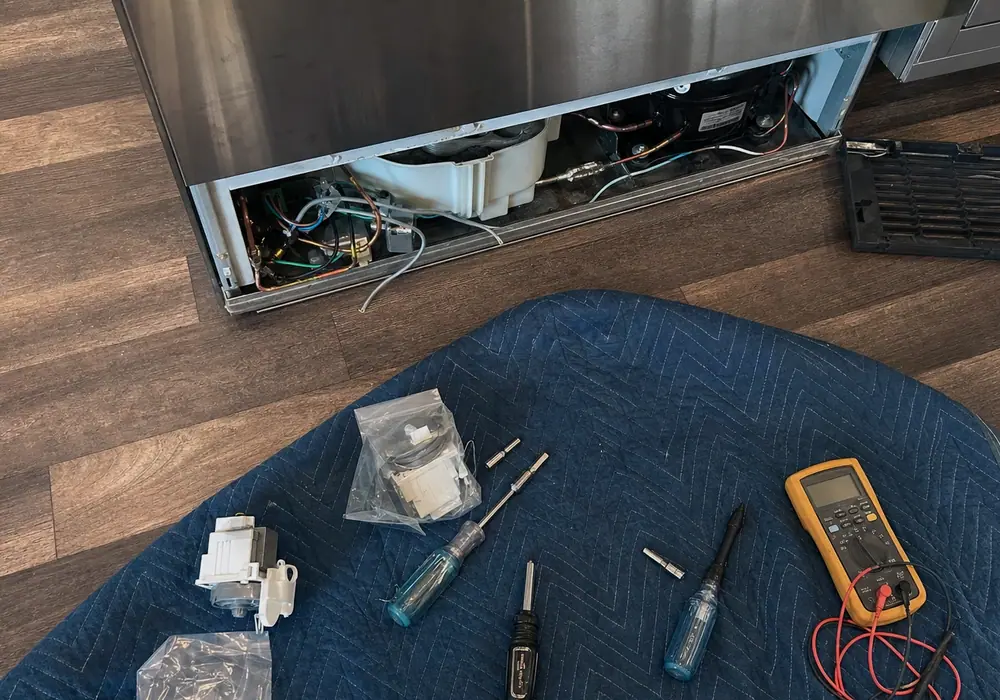
Most work on this equipment happens where it stands: the machine compartment opens off the lower grille, and the evaporators, fans and control boards come out from inside the cabinet. Sealed-system work is the exception, and in a retrofitted kitchen the answer to whether the appliance can be brought forward belongs before the quote rather than during the job. Scribed trim may have to come off. Flooring is often laid up to the case rather than under it, leaving a lip the rollers will not climb. Brackets fastening the unit to the cabinetry have to be located and released, and the water line and power dealt with first. That is not a homeowner job.
Retrofit faults are cheap; the sealed system is not
Almost all retrofit faults sit at the cheap end. A condenser cleaning, a hinge adjustment, a closer set correctly, a gasket, an evaporator fan, a thermistor or a defrost heater are ordinary parts and ordinary labor. Opening a blocked air path is carpentry, and it is often the most valuable thing anyone does to one of these installations. The expensive end is the sealed system: a compressor or a refrigerant leak on a unit that also has to be extracted from cabinetry built around it. Time connects the two, because a door that has not sealed for two summers has had the compressor working longer every one of those days.
Questions
Frequently asked questions
Does a built-in refrigerator need clearance at the sides?
It depends on the model, and the specification sheet is the only place worth reading. Front-breathing built-ins take air in and push it back out through the grille, so the grille opening matters far more than the side gaps. What is never acceptable is a valance or filler covering part of that opening, because intake and exhaust share it.
The unit has been in this opening for twenty years. Why is the door a problem now?
Hinge wear is gradual and gasket material hardens slowly. A door carrying a heavy panel loses alignment a fraction at a time, and for years the closer takes up the difference. When it can no longer manage the last half inch, the seal fails at one spot, usually high on the hinge side, and the symptoms all arrive at once.
Can a custom panel be made lighter?
Sometimes, and it is worth asking a cabinetmaker before assuming the appliance is at fault. A front built as a frame with a lighter center panel can look identical to a solid slab and weigh appreciably less. If the existing front is over the maximum panel weight in the documentation, hinge parts will keep failing however often they are replaced.
Appliance down in Mission Hills?
Tell us the brand and what it is doing — we can usually name the likely repair before we arrive.